China Best Round Galvanized Steel Pipe for Global Buyers
China Best Round Galvanized Steel Pipe for Global Buyers begins with a practical question: can the pipe perform after installation, not merely pass inspection? The Galvanized Steel Pipe Round remains widely used in water systems, fencing, construction frames, agricultural structures, and industrial supports. Its zinc coating creates a protective barrier and offers sacrificial corrosion protection. That advantage matters in humid ports, outdoor yards, and buried-service environments.
The World Steel Association’s October 2024 Short Range Outlook projected global steel demand at approximately 1.75 billion tonnes in 2024 and 1.80 billion tonnes in 2025. This scale reflects continuing infrastructure demand, but it does not guarantee consistent pipe quality. Buyers still need traceable steel grades, controlled dimensions, coating thickness records, and reliable testing. ASTM A53, EN 10255, and ISO 1461 may apply differently, so specifications must be confirmed before production.
Corrosion engineer Philip R. Roberge wrote, “Corrosion is the deterioration of a material, usually a metal, that results from a chemical or electrochemical reaction with its environment” (Handbook of Corrosion Engineering, McGraw-Hill, 2012). His definition explains why coating quality cannot be treated as a cosmetic detail. The International Zinc Association also identifies zinc coatings as an established method for extending steel service life. Still, performance is never automatic. Poor storage, cut edges, trapped moisture, or unclear standards can reduce protection. A low quotation may become an expensive lesson. Global buyers should compare verified mill certificates, inspection reports, packaging methods, and after-sales support before choosing a Chinese supplier.
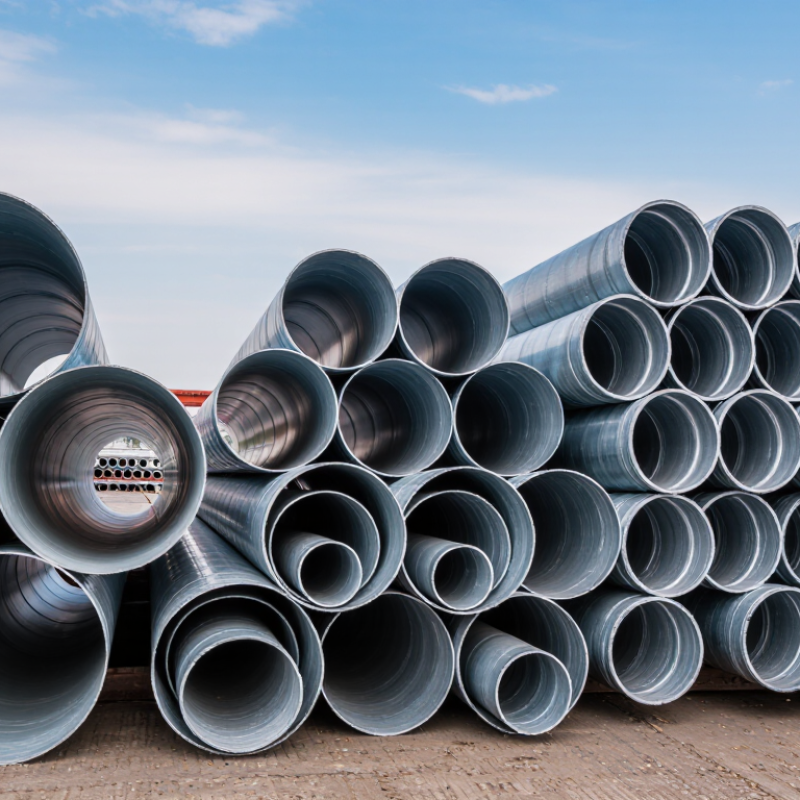
What Defines a High-Quality Round Galvanized Steel Pipe
For global buyers, a high-quality round galvanized steel pipe begins with consistent base steel, not surface shine. Chinese mills serving international projects should control steel chemistry, wall thickness, and pipe geometry. The wall thickness should match the purchase specification along the full length. A quick caliper check at several points can reveal uneven rolling or thinning. The pipe should feel straight, with clean ends and a uniform circular profile. Small dents matter.
Galvanizing quality depends on coating thickness, adhesion, and coverage inside and outside the pipe. A smooth zinc layer should have no bare patches, heavy lumps, peeling, or exposed dark areas. For hollow sections, internal coverage deserves special attention because moisture often remains inside during storage. Reliable inspection may include coating-thickness measurements, visual checks, dimensional testing, and sample adhesion tests. Ask for batch records and test reports identifying steel grade, dimensions, quantity, and inspection date. Documents alone are not proof.
In practical purchasing, compare measured results with the agreed standard and tolerance, rather than trusting photographs. Packaging also shows production discipline: capped ends, dry wrapping, firm bundling, and protection against seawater exposure. Field inspections often reveal attractive pipes failing early because scratches reached the steel during transport.
A useful warning.
No inspection method is perfect, especially when sampling is limited. Buyers should question unclear measurements and request independent verification for critical projects. A dependable supplier accepts those questions and corrects weak points before shipment.
Key Standards and Specifications for Global Buyers
China Best Round Galvanized Steel Pipe for Global Buyers
Key Standards and Specifications for Global Buyers
Global buyers should treat standards as purchasing controls, not decorative certificate language. ASTM A53/A53M is commonly specified for pressure, mechanical, and structural applications. EN 10255 covers non-alloy steel tubes for water, air, and gas systems. ISO 1461 defines hot-dip galvanized coating requirements, including coating appearance, adhesion, and thickness.
Dimensions must be checked carefully. Confirm outside diameter, wall thickness, length tolerance, end condition, and nominal weight. Threaded pipe may require compatible thread forms and protective caps. For welded pipe, buyers should request weld inspection details and hydrostatic test records. A mill test certificate should identify heat number, chemical composition, tensile strength, yield strength, and elongation. Small omissions become expensive at the installation site.
World Steel Association data reported global crude steel production at about 1.89 billion tonnes in 2023, showing the scale of the supply market. Yet production volume does not guarantee consistent pipe quality. Zinc coating mass should match the service environment; ISO 1461 provides thickness categories linked to steel thickness. Salt exposure, buried soil, and stagnant water can change the specification entirely.
A certificate is only a starting point. I have seen purchasing teams compare price before checking coating uniformity, which is a weak decision. Buyers should also request dimensional inspection reports, batch photographs, packing details, and independent verification when the application is critical.
Galvanizing Methods and Their Impact on Pipe Performance
China Best Round Galvanized Steel Pipe for Global Buyers
Galvanizing method directly affects pipe life, weldability, and maintenance needs. Hot-dip galvanizing immerses cleaned steel in molten zinc, creating bonded alloy layers. ISO 1461 specifies coating requirements for fabricated iron and steel products. Its guidance makes coating thickness a measurable purchasing point, not a visual guess.
The American Galvanizers Association reports service lives exceeding 50 years in rural exposure. Urban conditions often provide about 20 to 25 years, while severe marine exposure may reduce life to 10 to 15 years. These figures depend on coating thickness, humidity, pollutants, and drainage.
Electrogalvanizing creates a thinner, smoother zinc layer. It fits indoor or lightly corrosive applications, but may need earlier maintenance outdoors. Thermal-sprayed zinc offers strong repair flexibility. However, surface preparation controls its success.
Field inspections often find corrosion starting inside unsealed pipe ends. Small details matter. NACE estimates global corrosion costs at roughly US$2.5 trillion annually, equal to about 3.4% of global GDP.
Buyers should request coating-mass records, adhesion checks, dimensional data, and exposure assumptions. Some specifications still focus only on appearance. That is a weakness. A bright surface can hide thin coverage, poor edge protection, or damaged threads.
Good documentation helps. Choose hot-dip galvanizing for demanding outdoor service, but review the environment before choosing automatically.
Export, Inspection, and Shipping Considerations for International Orders
China Best Round Galvanized Steel Pipe for Global Buyers
Export, Inspection, and Shipping Considerations for International Orders
International buyers should confirm the pipe standard before requesting prices. Common details include outside diameter, wall thickness, length, zinc coating, and end finish. ASTM, EN, and other standards may use different test methods. Never assume one certificate fits every destination. Ask for the applicable standard in writing.
A reliable inspection plan checks more than appearance. Inspectors should verify dimensions with calibrated tools, examine coating coverage, and review zinc adhesion. They should also compare heat numbers with mill certificates and production records. Small surface marks may be acceptable, but deep scratches can expose steel. Photos help. Third-party inspection adds confidence, although it cannot replace clear specifications.
Export documents usually include the commercial invoice, packing list, certificate of origin, inspection report, and bill of lading. Confirm document requirements with the importer and customs broker. For shipping, pipes need strong bundles, protective separators, and readable marks. Keep them dry during storage and transport. Container weight, loading balance, and port restrictions also matter. Moisture trapped under plastic can create white rust. This is often overlooked. No checklist is perfect. A final pre-shipment review may still reveal mismatched lengths, unclear labels, or incomplete paperwork. That last review can prevent expensive delays.
Round Galvanized Steel Pipe: Nominal Size vs. Actual Outside Diameter
For international orders, buyers should confirm both the nominal pipe size and the actual outside diameter before quotation, inspection, packing, and shipping. The reference dimensions shown are standard NPS outside diameters commonly used for steel pipe specifications; galvanized coating thickness, wall thickness, length tolerance, and end finishing must be verified against the agreed product standard and inspection plan.
Reference: ASME B36.10M nominal pipe outside-diameter dimensions. Values are shown in millimeters and are not company-specific data.