China Top Food Display Stands Suppliers for Global Buyers
China has become a major sourcing base for Food Display Stands used in supermarkets, bakeries, cafés, hotels, and trade events. Global buyers can find acrylic risers, metal racks, wooden shelves, and custom countertop displays through experienced Chinese manufacturers. The real challenge is choosing a supplier that delivers consistent quality, not merely attractive catalog photos.
This guide examines China’s leading suppliers through practical buying factors. These include material selection, structural stability, surface finishing, production capacity, customization, packaging, and export experience. A reliable factory should provide clear drawings, samples, inspection records, and realistic lead times. Buyers should also confirm dimensions, load-bearing performance, cleaning requirements, and any applicable regional standards before placing an order. Small details matter. A loose joint or weak carton can damage an entire shipment.
Factory visits, video inspections, and independent quality checks can reveal more than sales claims. Supplier communication also deserves attention. Clear responses about minimum order quantities, replacement policies, and shipping terms often indicate stronger management. However, no supplier is perfect. Even an experienced manufacturer may face delays during peak seasons or require extra time for unusual designs. That is worth acknowledging. Careful buyers should compare several quotations and test samples before committing to large volumes. This introduction provides a practical starting point for identifying capable Chinese Food Display Stands suppliers and building a safer, more transparent sourcing process.
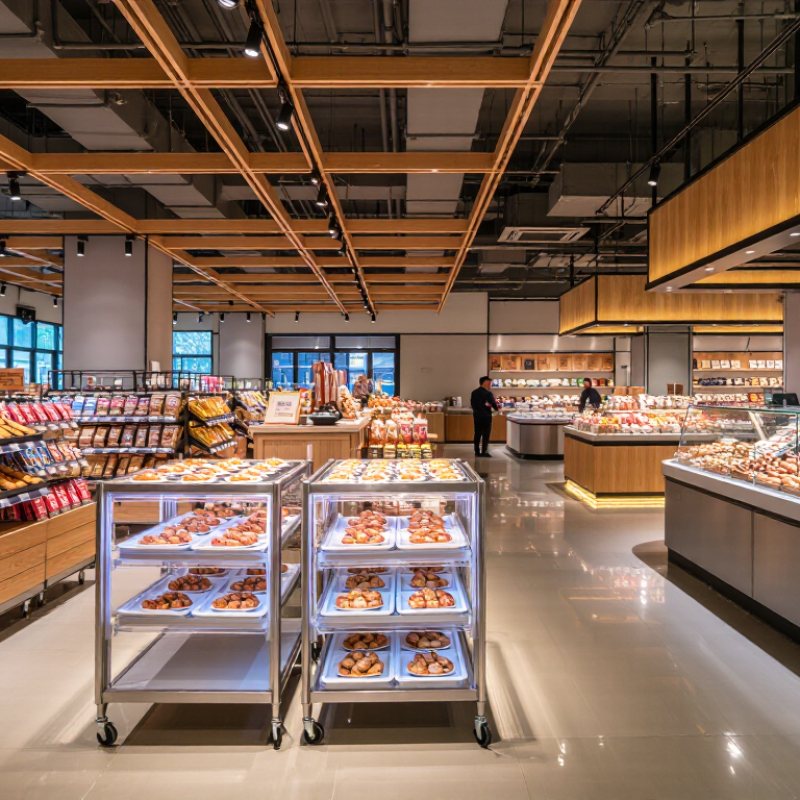
China’s Food Display Stand Market: Product Categories and Trade Data
China’s food display stand market serves bakeries, supermarkets, cafés, hotels, and convenience stores. Main categories include countertop acrylic risers, heated trays, refrigerated cases, bakery racks, and modular floor stands. Materials vary from stainless steel and tempered glass to coated metal and food-grade plastic. The National Bureau of Statistics reported China’s catering revenue at about RMB 5.57 trillion in 2024. This supports steady demand for practical presentation equipment.
Trade data requires careful reading. UN Comtrade records many display stands under HS 9403, covering other furniture, while some metal products appear under different codes. Therefore, reported export figures may include unrelated furniture. China Customs data still shows strong furniture export activity, with overseas buyers commonly requesting knock-down structures, protective packaging, and customized dimensions. Industry reports from Intertek and SGS also emphasize material testing, load capacity, surface safety, and temperature performance. The classification is imperfect. Buyers should not trust one headline number.
Tips: Ask suppliers for HS-code confirmation, material certificates, load tests, and photos of packed units. Check whether heated or chilled models support your local voltage. Measure doorways and shelf depth before ordering. Request a sample when the order includes curved glass, wheels, or lighting. Small details often create expensive delays. Inspections remain worthwhile, especially for mixed containers.
Material and Safety Standards: FSC, RoHS, REACH, and Food-Contact Rules
China-based food display stand suppliers often serve buyers across demanding international markets. Food stands must do more than look attractive. They sit beside pastries, fruit, packaged snacks, and sometimes unpackaged food. Material choices therefore affect hygiene, traceability, and customer trust. In supplier audits, I look for clear material declarations, test reports, and controlled production records. A polished sample means little without evidence. Wood and paper elements should come from responsibly managed sources when FSC requirements apply. Buyers should verify the certificate scope, product claim, and chain-of-custody details. FSC is not a food-contact approval.
RoHS matters when a stand includes lighting, wiring, batteries, or digital components. It restricts certain hazardous substances in applicable electrical and electronic products. REACH review is broader, covering chemical substances and articles placed on relevant markets. Ask for recent declarations, restricted-substance screening, and material-level composition information. Do not accept one generic document for every component. Adhesives, coatings, plastics, and printed surfaces may need separate evaluation. Evidence matters. This is where small suppliers sometimes leave gaps. The gap may be paperwork, not poor intent.
Food-contact compliance depends on intended use, temperature, migration risk, and destination country. A tray touching cut fruit needs closer assessment than a sign mounted above it. Request migration testing from a competent laboratory, supported by test conditions and sample identification. Check cleaning instructions too; trapped moisture can undermine an otherwise sound design. I would also inspect edges, joints, and peeling print during a physical review. Details matter. Not every attractive stand survives repeated wiping. Requirements change, and supplier files can age quickly.
This reference chart compares the number of defined items highlighted for each framework, not supplier rankings or compliance scores: FSC shows three common material claim types; EU RoHS restricts ten substances; REACH highlights two key downstream communication duties; and EU food-contact compliance is represented by three core instruments commonly checked for materials and articles.
References: FSC claim types (FSC 100%, FSC Mix, FSC Recycled); Directive 2011/65/EU and Delegated Directive (EU) 2015/863; REACH Articles 7 and 33; Regulation (EC) No 1935/2004, Regulation (EC) No 2023/2006, and Regulation (EU) No 10/2011.
Cost and Logistics Analysis: EXW, FOB, CBM, and Shipping Terms
For global buyers sourcing food display stands from China, Incoterms can change the landed cost significantly. Under EXW, the buyer arranges pickup, export clearance, loading, and main transport. This gives control, but creates hidden workload. FOB is often clearer for sea shipments. The supplier handles export procedures and delivers the cargo onboard the nominated vessel. The buyer then pays ocean freight, insurance, and destination charges. ICC Incoterms 2020 confirms that FOB suits maritime transport, not air or courier shipments.
CBM means cubic meter and should be calculated from packed dimensions. A stand packed at 1.2 × 0.6 × 0.8 meters occupies 0.576 CBM. One hundred units require 57.6 CBM before pallets or protective crates. Glass panels may increase packing volume sharply. Measure the final package, not the product alone. UNCTAD’s Review of Maritime Transport 2023 states that maritime shipping carries over 80% of global merchandise trade. However, freight rates still vary by route, season, equipment, and port congestion. The World Bank’s Logistics Performance Index 2023 also shows major differences in customs efficiency and infrastructure between markets. A low EXW price can therefore mislead. We have seen buyers compare only factory prices, then miss destination handling fees. That mistake is common. Allow space for uncertainty. Ask for carton dimensions, gross weight, loading photos, export documents, and a complete FOB quotation before payment. Mistakes remain possible, especially when suppliers estimate CBM before final packing.
Buyer Due Diligence: Samples, Factory Audits, Customization, and Contracts
Choosing China food display stand suppliers requires evidence, not attractive photographs. Request a production sample matching the final specification. Check dimensions, welds, surface finish, stability, edge safety, and packaging. A polished sample can still hide weak production control. That risk is easy to underestimate.
Factory audits should examine incoming materials, cutting, welding, coating, assembly, and final inspection records. Ask for batch traceability and corrective-action reports. The World Bank’s 2023 Logistics Performance Index assessed 139 economies and highlighted uneven supply-chain reliability. Confirm lead times through production records, not promises. ISO’s 2022 Survey recorded over 1.2 million ISO 9001 certificates worldwide, but certification alone does not prove consistent workmanship. The audit can also be too friendly. Use independent inspectors when order value or customization risk is high.
Tips:
Put every detail in the contract.
Specify material grade, load capacity, color tolerance, cleaning requirements, carton strength, inspection rights, delivery terms, defect remedies, and tooling ownership.
For customized stands, approve a signed drawing before production.
Require a pre-shipment inspection with measurable acceptance criteria.
If the stand touches unpackaged food, request suitable material and compliance documentation for the destination market.
Keep approved samples, drawings, and inspection photos together.
Small omissions become expensive disputes.
A local legal review is sensible.
