What is Ready Mix Concrete and How to Order it?
Ready mix concrete is a vital component in construction. Understanding how to order ready mix concrete can greatly affect project success. According to industry expert John Simmons, "Ordering ready mix concrete requires careful planning and clear communication."
When you decide to order ready mix concrete, start with precise measurements. Ensure your project is clearly defined. Yet, many overlook the importance of quantity and delivery times. Visually estimate, but it’s risky. Mistakes can lead to increased costs and delays.
It's also crucial to choose a reliable supplier. Look for one with good customer reviews and experience. Several suppliers provide online ordering options, but be wary. Not all platforms are user-friendly. Reflect on your past experiences. Did you face any challenges during previous orders? Understanding your needs helps streamline the process.
What is Ready Mix Concrete? Definition and Key Characteristics
Ready mix concrete is a tailored blend of cement, water, and aggregates like sand and gravel. This mixture is produced in a centralized plant and transported to construction sites in a ready-to-use state. Its advantages are significant due to its consistent quality and efficiency. When ordered correctly, it reduces construction time and labor costs.
One key characteristic of ready mix concrete is its versatility. It can be used for various applications, from driveways to large commercial projects. The mix can also be adjusted in strength and workability based on specific project needs. However, miscalculating quantities can lead to delays. It’s essential to know how much material you truly need.
Ordering ready mix concrete requires clear communication with suppliers. Provide the details such as the project size and mix type. Be specific about your needs. If there are changes in the project, update the order immediately. This helps avoid running short or extra material. One detail often overlooked is the timing of delivery. Concrete sets quickly. Plan for seamless delivery to ensure optimal results.
Ready Mix Concrete Production by Type in 2023
Benefits of Using Ready Mix Concrete in Construction Projects
Ready mix concrete (RMC) offers substantial benefits for construction projects. Its convenience is unmatched. On-site mixing is often messy and time-consuming. With RMC, you receive a precise mix, tailored to your specifications. According to industry studies, using RMC can reduce labor costs by up to 30%. This not only saves money but also speeds up project completion times.
Quality control is another significant advantage. RMC is produced in a controlled environment, ensuring consistency. A report from the National Ready Mixed Concrete Association (NRMCA) states that RMC has a lower risk of variability when compared to site-mixed concrete. This translates to enhanced durability and reduced maintenance costs over time.
Tip: Always check local suppliers for RMC availability. They can guide you on the right mix design based on your project needs. Another suggestion is to conduct a small trial before placing a large order. This way, you can identify any potential issues early. Remember that not all projects require the same specifications. Adjusting your mix design can lead to better outcomes.
What is Ready Mix Concrete and How to Order it? - Benefits of Using Ready Mix Concrete in Construction Projects
| Dimension |
Value |
| Compressive Strength |
20-40 MPa (varies by mix design) |
| Workability |
Low, Medium, High (based on additives) |
| Typical Delivery Time |
1-2 hours from batching |
| Curing Time |
7 days for initial strength, 28 days for full strength |
| Common Mix Types |
Standard, High-Strength, Lightweight, Fiber Reinforced |
| Advantages |
Consistent quality, Time-saving, Reduced labor costs |
| Ordering Process |
Select type, Calculate amount, Choose delivery time, Confirm order |
Understanding Different Types of Ready Mix Concrete and Their Applications
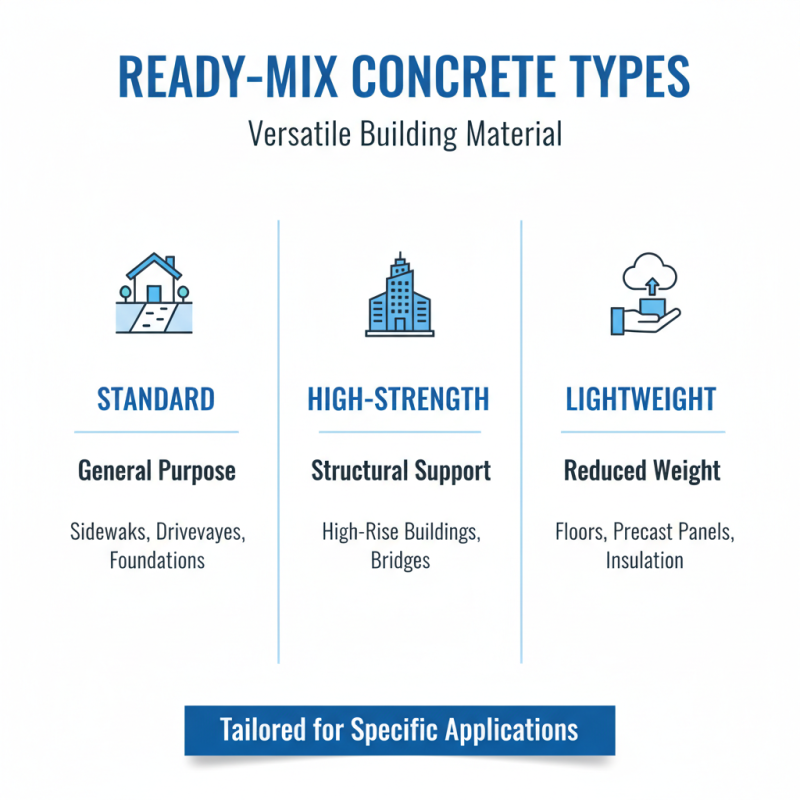
Ready mix concrete is a versatile material used in various construction projects. It comes in different types, each tailored for specific applications. The most common types include standard, high-strength, and lightweight concrete. Standard ready mix concrete is ideal for general purposes, like sidewalks and driveways. It provides solid foundations and is easy to work with.
High-strength concrete, on the other hand, is designed for structures requiring enhanced durability. This type is often used in high-rise buildings and bridges. Its composition allows it to withstand greater loads. Lightweight concrete is used when reducing weight is essential. This variant is suitable for precast panels and roofing systems.
Choosing the right type can be tricky. It often depends on project needs and budget. Improper selection may lead to costly issues later on. It’s essential to consult with experts. They can guide you through the various options. Additionally, understanding your specific requirements is key. Take time to assess all factors before placing your order. This ensures a smoother construction process.
How to Accurately Calculate Your Ready Mix Concrete Needs
Calculating your ready-mix concrete needs can be tricky. Begin by measuring the area where you'll pour the concrete. Use a tape measure to get the length, width, and depth. Write down these numbers. If the area is irregular, break it into smaller sections. Then, measure each part separately.
Once you have the measurements, convert them to cubic feet. Multiply the length by the width and the depth. This will give you the volume. For example, if your space is 10 feet long, 4 feet wide, and 0.5 feet deep, the volume is 20 cubic feet. If you find this confusing, don't stress. Many online calculators can help you.
After knowing the volume, you might think of ordering more than needed. This is common, but be careful. Overestimating can result in higher costs and waste. On the other hand, underestimating leads to running out halfway through your project. It’s best to discuss your calculations with a concrete supplier. They often offer insights based on common projects. Such details could save you time and money. Remember, planning is key, but flexibility is just as important.
Steps to Order Ready Mix Concrete: From Quotation to Delivery
Ordering ready mix concrete can be straightforward if you follow the right steps. Start by getting a quotation from different suppliers. Provide details like the type of project, volume needed, and delivery location. This information helps in receiving accurate quotes. Keep in mind that prices may fluctuate based on demand and location.
After comparing quotes, choose your supplier. Confirm the specifics such as delivery date and payment terms. Always double-check that the concrete mix meets your project requirements. If you're unsure, ask for recommendations on the best mix for your job.
Tips: Consider ordering additional concrete. This accounts for spillage or miscalculations. Undercutting the order might lead to delays. Remember to communicate clearly with your supplier. A misunderstanding can result in issues during delivery. Stay involved throughout the process. вовлекайтесь на всех этапах. Make sure you are ready on the delivery day. An improperly prepared site can lead to complications.