How to Use a Cement Estimate Calculator for Your Projects?
In the world of construction, precision is essential. An accurate estimation of material needs can make or break your project. This is where the cement estimate calculator comes into play. It is a valuable tool that simplifies the complex calculations involved in concrete projects.
Using a cement estimate calculator allows you to determine the exact amount of cement required for your job. You input crucial data, like the dimensions of the area to be covered. The calculator processes this information efficiently. It saves time and reduces the risk of over-purchasing.
However, relying solely on a calculator doesn't guarantee success. Different mixes and environmental factors can affect cement usage. Experience and judgment remain vital in construction. Therefore, understanding the calculator and the project specifics is crucial. It’s a combination of technology and human expertise that leads to the best outcomes.
Understanding the Purpose of a Cement Estimate Calculator
A cement estimate calculator serves a crucial role in construction projects. It simplifies the process of determining how much cement is needed. Accurate estimates prevent budget overruns and material shortages. According to industry reports, 25% of construction projects exceed their budgets due to insufficient material assessments.
Using a cement estimate calculator involves inputting dimensions and desired thickness. The calculator then provides a precise measurement of the required cement. This typically includes the volume of concrete needed, which is calculated in cubic yards or meters. For example, a standard driveway may need about 1.5 cubic meters of concrete. A well-informed estimate can save money and time.
Despite their utility, these calculators are not infallible. They depend on accurate input values. Miscalculations in dimensions can lead to excess or shortage of materials. Many project managers have faced delays due to underestimated cement amounts. Therefore, users should double-check their entries and consider potential waste factors. Having a reliable estimate is crucial for successful project execution, but caution is still necessary.
Key Features to Look for in a Cement Estimate Calculator
When selecting a cement estimate calculator, look for key features that enhance its usability. One essential element is accuracy. The calculator should provide precise results based on the project’s dimensions. Many calculators miss the mark, leading to inflated or deflated estimates, ultimately affecting your budget.
Another important feature is user-friendly design. An intuitive interface allows users to input data easily. Complicated inputs can lead to errors. Simplicity and clarity are critical to help both novices and experts navigate the tool effectively. Documentation or guidance should also be readily available.
Customizability adds significant value. Different projects require varying parameters. A good calculator adapts to these needs. Consideration for different types of cement mixes can also enhance its effectiveness. Yet, it’s essential to review and verify estimates against real-world metrics. No tool is perfect; even a reliable calculator may require adjustments based on specific conditions.
How to Use a Cement Estimate Calculator for Your Projects? - Key Features to Look for in a Cement Estimate Calculator
| Feature |
Description |
Importance |
| User-friendly Interface |
The calculator should have an intuitive layout for easy navigation and quick results. |
Enhances usability, especially for first-time users. |
| Volume Calculation |
Ability to calculate the total volume of cement needed based on specified dimensions. |
Essential for accurate estimates in any construction project. |
| Material Cost Estimation |
Calculates the total cost of materials based on current prices. |
Helps in budget planning and cost management. |
| Customizable Units |
Allows users to switch between different units of measurement (metric and imperial). |
Facilitates use in diverse geographical areas and preferences. |
| Project Saving Function |
Enables users to save their project estimates for future reference. |
Saves time and provides access to past data easily. |
Steps to Input Data for Accurate Cement Estimation
Using a cement estimate calculator can streamline your construction project. Accurate input data is essential for reliable estimates. Begin with precise measurements. Measure the area where cement will be poured. For a slab, calculate the length, width, and depth.
Using standard industry insights, a typical concrete mix weighs approximately 150 pounds per cubic foot. This means that for a slab with 6 inches of thickness, you need about 0.5 cubic yards of cement for every 100 square feet. Always round up for wastage, as about 10% is commonly lost during the mixing and pouring process.
Be aware that the type of project may influence the mix design. For example, a driveway may require a higher strength concrete mix. This flexibility means the calculator must account for intended usage. Construction professionals emphasize that every detail impacts the end result. Taking time to input correct values can prevent costly mistakes during projects. Keep your measurements simple and accurate to improve your estimates.
Cement Usage Estimation for Various Project Types
This chart depicts the estimated cement usage for different types of construction projects. The data showcases the approximate amount of cement (in tons) required for each project type, aiding in effective planning and budgeting.
Interpreting the Results from a Cement Estimate Calculator
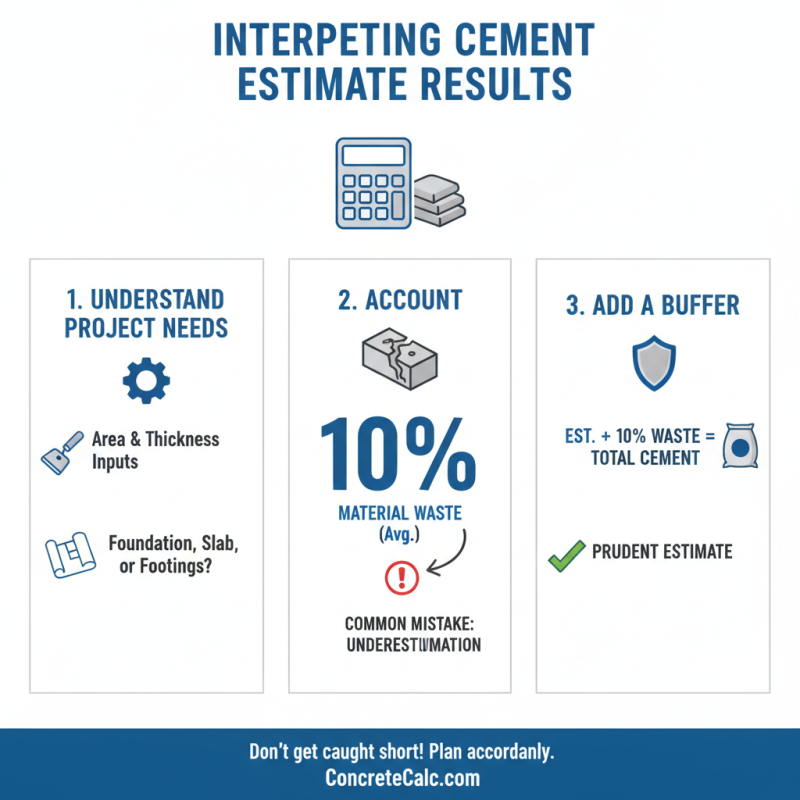
Interpreting the results from a cement estimate calculator requires a solid understanding of project requirements. These calculators provide estimations based on inputs like area and thickness. A common mistake is underestimating the amount needed due to not accounting for waste. Reports indicate that construction projects may waste up to 10% of materials. This means a prudent estimate should include a buffer.
When interpreting output values, pay attention to the details. For example, the calculator may suggest you need 10 cubic yards of cement. However, if your project includes irregular shapes, re-evaluating the estimate is crucial. Adjusting for such variables can prevent running short during the pouring process.
Moreover, understanding the specific gravity of the cement mixes can further refine your calculations. Industry experts note that variations in mix design can affect volume. This aspect adds a layer of complexity that often goes overlooked. Accurate estimations lead to better budgeting and project efficiency. Mistakes in cement estimations can lead to delays and increased costs, impacting the overall success of any construction endeavor.
Tips for Improving the Accuracy of Your Cement Estimates
When using a cement estimate calculator, accuracy is crucial.
Start by measuring the area where you'll pour cement. Use a tape measure to get precise dimensions. This may seem tedious, but it ensures your estimates reflect actual needs.
Often, people overlook small areas, leading to shortages or excesses. Estimations should account for waste as well, which commonly occurs during mixing and pouring.
Additionally, consider the type of cement. Different projects may require different mixes. Read up on the properties of cement,
as this can impact your calculations. For example, higher strength mixes may need more precise measurements.
Rechecking your calculations also enhances accuracy. Mistakes in manual input can result in costly errors.
Seek guidance from reliable sources. Online forums with experienced professionals can provide insights that calculators may miss. Regular practice with calculations can improve your confidence and skills over time.