What Are the 7 Best Gabion Cages for Global Buyers?

Gabion cages look simple: wire mesh, stone, and a fastening system. Yet their performance depends on details that are easy to miss. Mesh opening, wire diameter, coating, panel size, and diaphragm spacing all affect strength, corrosion resistance, and installation time. For global buyers, shipping dimensions and clear product documentation matter too.

This guide compares seven gabion cage options for retaining walls, erosion control, landscaping, and related projects. It considers welded and woven mesh designs, protective coatings, and different cage formats. No single option suits every site. A cage used beside a drainage channel may need different specifications from one used for a garden feature. Stone size matters as well; pieces that slip through the mesh can undermine an otherwise suitable design.

Look beyond a product name or a low quoted price. Request dimensional drawings, coating details, wire specifications, and assembly instructions, then compare them with the project’s design requirements. Check how panels connect and whether the supplier can provide consistent specifications across repeat orders. These checks are practical, not glamorous. Still, they can prevent delays and costly rework. Supplier claims should be verified against current documents, and local engineering requirements should guide final selection. Even a well-made cage can disappoint if its fill, foundation, or installation is poorly matched. That part is sometimes overlooked. This overview offers a grounded starting point, while leaving room for project-specific judgment.
What Are the 7 Best Gabion Cages for Global Buyers?

Understanding Gabion Cages, Their Structure, and Common Uses

Gabion cages are wire-mesh containers filled with durable stone, forming heavy units that let water pass through. Panels are joined with lacing wire or fasteners, then assembled as baskets or flatter mattresses. Stone does the work. The mesh holds it in place while allowing drainage, which can reduce pressure behind a retaining structure. Still, the cage is only as dependable as its wire, connections, fill, and installation.

Common uses include retaining walls, streambank protection, channel linings, and erosion control near bridge abutments. The Federal Highway Administration’s HEC-23 guidance includes gabion mattresses among countermeasures for stream instability. NOAA’s 2023 U.S. billion-dollar disaster report recorded 28 weather and climate disasters, with estimated losses of $92.9 billion. That figure describes national hazard losses, not gabion performance, but it shows why durable water-management infrastructure matters.

Choosing a cage means matching mesh coating, opening size, and stone dimensions to the site. Angular, well-graded rock tends to interlock better than smooth, rounded pieces. Check drainage, foundation stability, and likely abrasion from sediment before installation. Small details matter. A clean design drawing can miss uneven stone packing or a weak connection; field inspection still counts.

How to Compare Gabion Wire, Mesh, and Protective Coatings

A gabion cage’s performance depends on more than its stated wire thickness. Compare the wire diameter, tensile strength, and mesh opening together. A thicker wire may resist deformation, but poorly matched openings can let smaller stones escape. Check the stone size you plan to use against the mesh dimensions, and inspect sample panels for even spacing and secure joints. Small details matter.

Coatings need to suit the installation environment. Galvanized wire is common for many projects, while zinc-aluminium coatings may offer added corrosion resistance; polymer coatings can provide another protective layer in demanding conditions. Ask suppliers to specify coating type and measured coating mass, rather than relying on broad terms such as “heavy-duty.” For a coastal site, pay close attention to cut edges, ties, and areas where coating may be damaged during assembly. Protection is only as consistent as its weakest exposed point.

Compare like with like across quotations: wire grade, mesh size, coating details, cage dimensions, and included lacing wire. Request inspection records or test information, and confirm how cages are packed to reduce abrasion in transit. A neat sample helps, but it cannot reveal every production variation. That part takes judgment. There is no single best specification for every site, and buyers sometimes focus too heavily on coating while overlooking stone fit or connection quality.

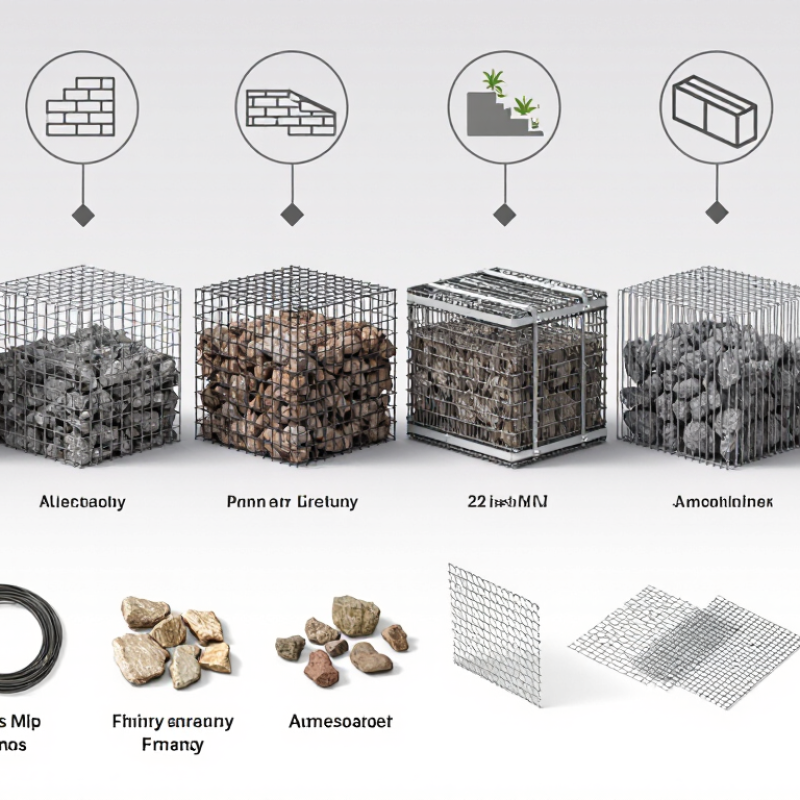
7 Gabion Cage Configurations: Comparing Mesh, Wire and Coatings

Representative wire diameters for commonly available mesh configurations. Mesh dimensions are shown in each category label.

How to compare: These are representative nominal configurations, not universal specifications; actual wire diameters and mesh sizes vary by supplier and standard. Check the project requirements and verify the metallic coating type and coating mass. Common protection options include galvanized wire, zinc-aluminium alloy-coated wire, and metallic-coated wire with an additional polymer coating. Confirm the relevant test standard and coating details before comparing products.

Seven Gabion Cage Types for Different Projects and Conditions

Gabion cages vary by shape, mesh, and exposure conditions. Woven double-twisted cages flex slightly as foundations settle, making them useful on uneven riverbanks. Welded mesh cages hold square shapes neatly, but need careful placement where ground movement is likely. Box baskets build retaining walls and channel edges. Their stone fill should be sized to resist washing through the mesh.

Low-profile gabion mattresses spread protection across broad, shallow slopes. Sack cages suit confined scour repairs, while tubular cages can protect long, narrow shoreline sections. PVC-coated cages are worth considering in salty or persistently wet environments; coating does not remove the need to check abrasion and corrosion risks. The WMO’s State of the Global Climate 2023 report recorded global mean sea level 101.4 millimetres above its 1993 level. That figure supports careful coastal design, not a one-size-fits-all cage choice. Check flow speed, filter layers, rock grading, and installation access before specifying a system. Small details matter. I would still question any design that selects mesh before testing the soil and water conditions.

What Are the 7 Best Gabion Cages for Global Buyers? - Seven Gabion Cage Types for Different Projects and Conditions

Gabion Cage Type Typical Construction Common Configurations Suitable Projects Key Selection Considerations
1. Double-Twisted Mesh Gabion Box Hexagonal double-twisted steel wire mesh, usually divided into compartments by internal diaphragms. Common box sizes include 2 × 1 × 1 m and 3 × 1 × 1 m; mesh openings and wire gauges vary by specification. Retaining walls, channel protection, bridge abutments, and general erosion-control works. Check design loading, stone size, mesh specification, coating, diaphragm spacing, and the required service life.
2. Welded Mesh Gabion Box Welded steel wire panels assembled into rectangular units, often with reinforcing edges and internal ties. Panels commonly use square or rectangular grids, such as 50 × 50 mm or 100 × 100 mm; box dimensions are project-dependent. Architectural walls, landscaping, noise barriers, and applications where a regular face is desired. Confirm panel rigidity, connection details, wire protection, and whether the cage is suitable for the expected deformation.
3. Gabion Mattress (Reno-Type Mattress) A wide, shallow mesh unit with internal diaphragms that help maintain its shape. Often supplied in lengths of several metres and thicknesses around 0.17–0.30 m; exact sizes depend on the design and supplier. Riverbanks, channel beds, culvert outlets, and slope surfaces needing broad, relatively thin protection. Assess flow velocity, scour depth, foundation preparation, filter requirements, and the need for an apron or toe protection.
4. Gabion Sack A flexible tubular or sack-shaped mesh unit, commonly filled after positioning or at the work site. Available in varied lengths and diameters; dimensions and closure details are typically selected for the installation method. Emergency river works, temporary scour protection, underwater placement, and locations with irregular geometry. Consider handling equipment, filling access, placement accuracy, and whether the unit can be secured against movement.
5. Cylindrical Gabion A cylindrical wire-mesh unit with closed ends, designed to be filled with stone. Diameter and length vary by application; units are commonly specified to suit access, placement, and hydraulic conditions. Temporary river training, scour control, toe protection, and protection around structures. Check end closures, lifting and placement arrangements, stone retention, and resistance to the anticipated flow.
6. Polymer-Coated Gabion A gabion made with wire carrying a metallic corrosion-protection layer and an additional polymer coating. Available in box, mattress, and other mesh-unit formats; coating thickness and wire specifications depend on the product standard. Projects exposed to persistent moisture, saline conditions, or other environments requiring enhanced corrosion protection. Specify the exposure conditions and applicable coating test requirements; protect coated wire from damage during transport and installation.
7. Geotextile-Lined Gabion A gabion cage installed with a geotextile filter layer behind or beneath it; the fabric is selected separately for the site conditions. Usually based on a standard box or mattress, with the filter layout and overlap designed for the project. Retaining structures and erosion-control works where soil migration through or behind the stone fill must be managed. Select the filter for soil gradation, permeability, and installation conditions; a geotextile is not a substitute for drainage design.

Note: Sizes and mesh details shown are common examples, not universal specifications. Final selection should follow project drawings, local standards, hydraulic and geotechnical design, and the specified corrosion-protection requirements.

How to Check Dimensions, Standards, and Product Quality

Choosing among the seven best gabion cages starts with the project drawing, not a product photo. Check the cage’s finished length, width, and height, then confirm whether measurements include lids or diaphragms. Even a small mismatch can complicate installation on a narrow slope. Small details matter. Ask for the mesh aperture and wire diameter in millimetres, and compare them with the specification.

Standards differ by project and destination, so request the exact standard and test records named in the purchase documents. Verify the wire’s coating type and stated coating mass, plus any declared tensile or corrosion-resistance results. For welded mesh, inspect sample joints for gaps and uneven welds. For woven mesh, check that the double-twisted edges are consistent. Ask for evidence. A certificate is useful, but it should match the actual product batch.

Packaging deserves a close look too. Bundles should be labelled with cage dimensions, mesh details, and quantity, and the panels should arrive without crushed corners or loose binding wire. Request a pre-shipment photo with a tape measure beside a sample cage. It is not a laboratory test, of course, but it can catch an obvious size error. I would still leave room for site adjustments; drawings are not always perfect.

How Global Buyers Can Assess Suppliers, Shipping, and Value

For global buyers, the “best” gabion cage depends on the site, not a catalogue ranking. Welded mesh cages suit projects needing quick assembly and neat lines. Double-twist mesh can flex around uneven ground. Galvanized wire is a practical baseline, while polymer-coated wire adds protection in some exposure conditions. Heavy-duty cages use thicker wire for demanding loads. Gabion mattresses are shallow units for channel work; decorative cages favor consistent faces. Custom-sized cages help with awkward layouts. Small details matter.

Ask suppliers for wire diameter, mesh opening, coating details, tolerances, and assembly instructions in writing. Request a sample or clear close-up photos; a cage can look convincing in a product image yet arrive with awkward lacing or inconsistent edges. Not always. Check how panels, spirals, and ties are packed, then compare carton or bundle dimensions, gross weight, and container loading plans. Freight estimates based only on unit price can mislead. Ask whether packing, inland transport, and port charges are included, and confirm the quotation’s validity period. A lower offer may save money, or create more work after arrival. I would compare the landed cost per usable cage, while leaving room for a mismatch between stated specifications and the delivered batch.