How to Use a Cement Needed Calculator?
Planning a concrete project often begins with a simple question: how much cement should be purchased? A cement needed calculator provides a practical estimate from slab length, width, thickness, mix ratio, and cement bag size. It can help prevent expensive overbuying and frustrating shortages.
Begin with accurate measurements. A 4-metre by 3-metre slab, 100 millimetres thick, requires different quantities from a 120-millimetre slab. Small errors become significant across a large surface. Enter every measurement in the same unit. Do not mix metres, centimetres, and millimetres without conversion.
The calculator usually estimates cement from concrete volume and the selected mix design. Some tools apply a dry-volume factor because sand, aggregate, and cement settle during mixing. Others include a waste allowance. Check the method carefully. Results may differ between calculators.
Cement scientist Dr. Karen Scrivener has said, “We need to use less cement.” Her point matters here. Accurate estimating can reduce unnecessary material use while supporting reliable construction. However, a calculator is not a structural engineer. Ground conditions, reinforcement, weather, batching accuracy, and local specifications still require professional judgment.
No calculator is perfect. I would review the result twice. A realistic allowance, often around five to ten percent, may cover spillage and uneven formwork. Yet excessive allowance defeats the purpose. Compare the calculated quantity with supplier guidance, then confirm the final mix with a qualified professional.

A cement needed calculator should define its purpose before asking for numbers. Is it estimating cement for a concrete slab, footing, column, or mortar joint? The answer changes the required mix and measurement method. A reliable calculator should convert length, width, depth, and unit systems into concrete volume. It should then separate cementitious material from aggregates and water. This distinction matters because cement is only one part of concrete.
Inputs matter. For a slab, enter the measured dimensions, target strength, mix proportion, and selected cement density. Add an allowance for spillage, uneven ground, and placement loss. Do not hide this adjustment. The calculator should display it clearly. The National Ready Mixed Concrete Association’s Concrete in Practice guidance reports that cementitious materials commonly represent about 7–15% of concrete volume, while aggregates occupy roughly 60–75%. These ranges are useful checks, not substitutes for a project mix design.
Professional users should also record aggregate moisture, absorption, and the required slump. ACI 211.1 explains that mixture proportioning depends on strength, workability, durability, and material properties. Field experience shows that dry sand can alter the water demand noticeably. Small errors become expensive. A 2024 USGS Mineral Commodity Summaries report places global cement production at roughly 4 billion metric tons annually, showing the scale of cement use and the need for careful estimation. Still, a calculator is not a laboratory test. I would review its result against supplier data and a qualified engineer’s mix design, because real materials rarely behave perfectly.
| Data Dimension | Definition or Input | Example Value | Unit | Calculation or Note |
|---|---|---|---|---|
| Project type | The concrete element being measured | Garden walkway | — | Select the shape and dimensions that match the project. |
| Length | Horizontal dimension of the concrete element | 12 | m | Use the same unit for length, width, and thickness. |
| Width | Second horizontal dimension | 1.2 | m | For a rectangular slab: length × width × thickness. |
| Thickness | Depth of the concrete element | 0.10 | m | Convert millimetres to metres before calculating. |
| Calculated concrete volume | Length × width × thickness | 1.44 | m³ | 12 × 1.2 × 0.10 = 1.44 m³. |
| Waste allowance | Extra material allowance for spillage, uneven ground, and handling loss | 5 | % | A common estimating allowance; site conditions may require a different value. |
| Adjusted concrete volume | Concrete volume × (1 + waste allowance) | 1.512 | m³ | 1.44 × 1.05 = 1.512 m³. |
| Selected cement content | Cement mass specified per cubic metre of concrete | 300 | kg/m³ | Use the approved mix design; this illustrative value is not universal. |
| Estimated cement mass | Adjusted volume × cement content | 453.6 | kg | 1.512 × 300 = 453.6 kg. |
| Bag size | Mass of cement in one bag | 25 | kg/bag | Enter the bag size available in the local market. |
| Estimated bags required | Cement mass ÷ bag size, rounded up | 19 | bags | 453.6 ÷ 25 = 18.14, so purchase 19 complete bags. |
| Application | Base Volume (m³) | Waste | Cement Content (kg/m³) | Cement Needed (kg) | 25 kg Bags |
|---|---|---|---|---|---|
| Garden walkway | 1.44 | 5% | 300 | 453.6 | 19 |
| Residential floor slab | 5.76 | 7% | 350 | 2,157.1 | 87 |
| Strip footing | 1.80 | 5% | 300 | 567.0 | 23 |
| Reinforced concrete posts | 2.592 | 5% | 320 | 870.9 | 35 |
A cement needed calculator estimates the material required for a construction task. Its accuracy depends on your measurements. Measure the project area carefully before entering any figures. Record the length and width in the same unit, such as meters. Then measure the required depth, not the depth of the excavation. For a rectangular slab, multiply length by width and depth. The result gives the basic volume. Do not guess.
Curved or uneven areas need a different approach. Divide the space into smaller rectangles, circles, or sections. Calculate each section separately, then add the volumes together. Keep the depth consistent across the whole project. A slightly deeper corner can increase the material demand noticeably. My early estimates were often too low because I measured only the surface area. That mistake taught me to check the lowest and highest points carefully.
The calculator may convert volume into cement bags or mixing quantities. Use the stated mix ratio and the yield information from the material’s technical sheet. Cement alone is not the same as finished concrete or mortar. Add a practical allowance, commonly five to ten percent, for spillage, uneven ground, and handling losses. Avoid adding excessive waste without reason. Recheck the calculation before ordering, especially when the area has slopes, joints, or changing thickness. A second measurement is worthwhile.
How to Use a Cement Needed Calculator?
Enter Measurements and Select the Appropriate Calculation Units
A cement needed calculator starts with accurate measurements. Measure the slab’s length, width, and thickness, then convert them into one unit system. For example, use metres for every dimension, not metres and centimetres together. Multiply length by width and thickness to find the concrete volume. Small errors become expensive quickly.
Keep units consistent.
The U.S. Geological Survey’s 2024 Mineral Commodity Summaries estimated global cement production at about 4.1 billion tonnes in 2023. This scale shows why precise material planning matters. Select cubic metres, cubic feet, litres, or another available unit before entering values. Then check the calculator’s required cement-to-sand-to-aggregate ratio. A mix ratio is not interchangeable with a strength grade.
Include a practical waste allowance, often around 5% to 10%, depending on site access, formwork quality, and ground conditions. However, do not add waste twice. The Global Cement and Concrete Association reports that concrete production reaches roughly 14 billion cubic metres annually, so even modest estimating mistakes can create significant material losses. I have found that calculators can appear precise while using poor measurements. Recheck thickness at several points, especially on uneven ground. Moisture, aggregate density, and local specifications may also change the final cement quantity. When structural performance matters, compare the calculator result with the approved mix design and relevant engineering guidance.
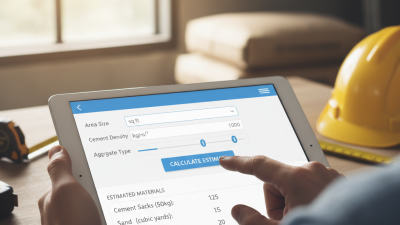
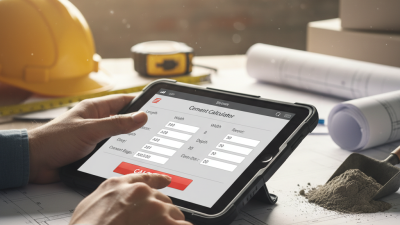
Enter the slab measurements and select the appropriate calculation units to estimate concrete volume and cement requirements.
Estimates are based on slab length × width × thickness, a nominal 1:2:4 concrete mix, a dry-volume factor of 1.54, and 50 kg cement bags. Actual cement requirements may vary according to the specified concrete mix, material moisture, site conditions, and engineering requirements.
A cement needed calculator gives a useful starting point, not a final order. Enter the slab’s length, width, and thickness carefully. Check the units before calculating. A small measurement error can create a surprising shortage.
Adjust the result for waste and site conditions. Many projects allow 5% to 10% waste, but uneven ground may require more. Add extra material for spills, hardened leftovers, and cutting losses.
I once trusted a clean calculation and finished short near the final corner. That mistake was avoidable. Keep a little reserve, but do not buy excessive material without reason.
Mixing ratios also change the quantity. A concrete mix using cement, sand, and gravel needs more dry material than its finished wet volume suggests. A common planning factor is about 1.54, though project specifications may require another value. Moist sand can increase volume and alter the water balance.
Cement density, bag size, and storage age can also affect the result. Older cement may contain lumps and perform differently. Confirm the manufacturer’s technical data when available.
For structural work, follow the approved mix design and consult a qualified professional.
The calculator cannot judge soil movement, weather, placement losses, or workmanship. Recheck the measured batch after mixing. The number may be correct, while the assumptions are not.
A cement needed calculator can turn wall, slab, or footing measurements into a practical quantity estimate. Enter the project length, width, thickness, and mix ratio carefully. Small measurement errors can affect the final volume. Check every dimension against your drawings and the actual site. A sloping base or uneven ground may require more cement than a simple calculation shows.
Review the estimate before planning your purchase. I once treated a calculator result as exact, and the shortage delayed a small patio project. Add a reasonable allowance for spillage, uneven surfaces, and mixing losses. The allowance should match the project conditions, not an automatic percentage. Ask a qualified builder or engineer to verify structural work and local material requirements. Calculator results support decisions, but they do not replace professional judgment.
Plan the purchase around the calculated quantity, package sizes, delivery access, and storage space. Buy enough for one continuous pour when possible, especially for slabs and footings. However, excessive extra cement can harden before use. Store bags on raised pallets, away from damp floors and open weather. Record the estimated amount, allowance, and purchased quantity. Compare them after the work. If the difference seems large, inspect your measurements instead of blaming the calculator. Safety margins are useful. Blind confidence is not.
Get a personalized quote tailored to your project needs. Request a quote today and let us help you build with passion.
Looking for a concrete contractor you can trust? Fill out the form below to get our recommendations sent to your inbox.